

If you love qigong and you're wondering whether you can make a living teaching it, you deserve an honest answer, not hype. The short version: yes, qigong teaching can support you, but income varies enormously based on how you structure your business, not just how well you move. In this guide I'll walk you through realistic pay figures as of 2026, how each business model earns, and the levers that take you from supplementing your income to building a full practice.
I'm Tevia Feng, founder of White Tiger Qigong. I have practised Qigong for over 40 years and have taught since 2008. Over that time I've watched teachers succeed and struggle, and the difference is rarely talent. It's structure. If you're still at the stage of choosing a program, start with our overview of qigong teacher certification, then come back here for the money side. Let's break it down.
What Qigong Teachers Actually Earn (2026 Averages)

Feel this in your own body — free 5-Day Qigong Challenge
Five short guided sessions. Release tension, breathe deeper, and feel your energy return — starting today.
Instant access. No spam — unsubscribe anytime.
Let's start with the numbers people quote. As of October 2026, ZipRecruiter lists the average annual pay for a qigong instructor in the United States at about $48,000 a year, or roughly $23 an hour. Most reported salaries fall between $31,500 and $56,500, with top earners (90th percentile) around $78,500. Hourly figures on the same page range from about $8 to $45 an hour depending on setting and experience.
A few caveats before you build a budget around these figures. First, they reflect employed or contracted positions: instructors hired by studios, gyms, hospitals and wellness centers. Many qigong teachers are self-employed, and their income looks nothing like a salary line. Second, "average" hides a wide spread. A brand-new teacher leading two community classes a week and an established instructor running an online membership are both "qigong teachers," but they may be an order of magnitude apart in earnings. Third, salary aggregators estimate from job postings and user reports, so treat them as a rough guide rather than a census. Fourth, these are United States figures. If you teach anywhere else, read the section on researching your own market below.
So treat the $48k figure as a useful anchor for employed roles, not a ceiling or a promise.
Your actual income depends almost entirely on the business model you choose.
The Full Range: From Part-Time Teacher to Seven Figures
Salary tables only show the middle of the market. The real range for qigong teachers is far wider than any average. Here is the sliding scale I see after nearly two decades of teaching and training teachers. Treat these as typical ranges in major Western cities, not promises.
- New teacher: community and donation classes, a few paid privates, usually alongside another job. Privates often sit around $40 to $80 an hour.
- Established local teacher: a full weekly timetable, regular private clients and the occasional workshop. Privates often sit around $80 to $150 an hour, and total income can match or pass the salary figures above.
- Senior or specialist teacher: a clear niche, retreats, corporate work and an online offer. Privates often sit around $150 to $300 an hour.
- The top of the field: the best-known qigong teachers charge $500 to $1,000 an hour or more for private sessions, when they offer them at all.
At the very top, a small number of qigong teachers have built businesses that bring in millions of dollars a year. They got there over decades, through TV programs, books, large online course libraries, their own teacher certification programs and international retreats. They are the outliers, not the norm. But they prove something important: the ceiling in this field is far higher than any salary table shows, and it is set by the business you build, not by an hourly wage.
Income by Business Model
Most working qigong teachers blend several of the streams below. Here's how each one works in practice.

Group Classes
Group classes are where most teachers start. You rent space (a studio, community center, park, or a yoga studio's off-peak slot) and charge per head. To see the math, take an example: a class of ten students at $20 each grosses $200 before you subtract space rental and travel. Your own price will depend on your local market, so check what comparable movement classes near you charge.
The math is simple but the constraint is real: your income is capped by how many people fit in the room and how many classes you can physically teach. Two well-attended evening classes a week can add a meaningful sum each month, but you're trading time for money with a hard ceiling. The upside is that group classes build community fast, give you reps as a teacher, and feed every other stream. The students who first meet you in a community class are the same people who later buy your private sessions, your online course and your membership. Treat group classes as both income and your most effective marketing channel.
Private Sessions
One-on-one and small-group privates command far higher rates per hour than a group drop-in, and more again in major cities or for specialized work. Privates are how many teachers stabilize their income early, because a handful of committed regulars provides predictable cash flow. As the sliding scale above shows, private rates run from tens of dollars an hour for new teachers to $500 to $1,000 an hour at the very top.
The trade-off is the same as group classes, only more so: privates are the most time-intensive way to earn. They're excellent as part of a mix, but they don't scale on their own. The smartest teachers use privates strategically, as a premium offer for students who want personalized attention and as a deep well of insight into the exact problems your future courses and group programs should solve. A few private clients will teach you more about what people actually need than a hundred drop-ins.
Corporate and Wellness Contracts
This is one of the most underrated income streams in qigong, and it's where professionalism pays off directly. Companies, senior-living facilities and wellness programs contract movement instructors for stress, mobility and team-wellbeing sessions. Rates for this kind of work generally climb with experience, and a contractor who can run a structured program for an organization is usually paid well above a public class rate.
Qigong is a strong fit here because it's low-impact, needs almost no equipment, and frames cleanly around stress relief, mobility and energy, the exact outcomes corporate buyers want. Landing even one recurring corporate contract can outearn a week of public classes. Institutional clients also tend to require credentials and insurance, which is one more reason training to a recognized standard matters (more on that below).
Online Courses and Memberships

This is where the income ceiling disappears. Instead of being paid once per person in a room, you build a course or membership library once and sell it repeatedly. Wellness is a durable category for online learning because people keep investing in their health.
Realistic expectations matter here. Results vary widely: many new course creators earn little at first, while a smaller number with an engaged audience build a substantial income. A monthly membership, for example a video library plus a weekly live Zoom class, turns sporadic sales into recurring revenue, which is the single biggest stabilizer in a teaching business.
Online is not passive or instant. It usually takes a year or more of consistent effort to build an audience and a content library. But it's the only model on this list where your income isn't capped by your calendar. If you're weighing how to train for this kind of teaching, our comparison of online vs in-person qigong teacher training covers the trade-offs.
Teaching Outside the United States? Research Your Own Market
Our students come from more than 80 countries, so please don't copy US prices. Pay for qigong teachers varies hugely by country and by city. A rate that works in London, Sydney or Zurich may not work in a small town, and a rate that is normal in a small town may undersell you in a capital city. Before you set your prices, spend an afternoon on simple market research:
- Check local class prices. Find what yoga, Pilates and tai chi studios near you charge for a drop-in class and a class pass. Qigong usually prices close to these.
- Check local private rates. Look at what yoga teachers, massage therapists and personal trainers in your area charge per hour. That is your private-session benchmark.
- Check salary sites for your country. ZipRecruiter covers the US. Search the main job and salary sites where you live for qigong, tai chi or yoga instructor pay.
- Ask the people who hire. Studios, gyms, community centers and senior-living facilities will often tell you what they pay contract instructors per class.
- Price online offers for a global audience. Online, your students can live anywhere. Your local market sets a floor for your online prices, not a ceiling.
Use the US figures and the sliding scale in this guide as a shape, then fill in the real numbers for where you teach.
What Actually Raises Your Rate
Two teachers with identical movement skills can charge very different prices. Here's what separates them.
A clear niche. "I teach qigong" is a commodity. "I teach qigong for desk workers with chronic neck and shoulder tension" is a service someone will pay a premium for. A specific audience lets you charge more and market more easily.
Demonstrable results. Not health claims, because qigong is a movement and wellness practice, not a treatment or cure for disease. What counts is the lived outcomes your students report: better mobility, less daily stress, steadier energy, improved balance. Testimonials and student stories justify higher prices better than any credential.
A real brand. A recognizable name, consistent content and a body of work (videos, writing, a method people can name) let you charge what generalists can't. Brand is slow to build and compounds for years.
Credible certification. A recognized qigong teacher certification signals to studios, corporate buyers and students that you've been trained to a standard. It's often expected for institutional contracts and is a meaningful trust signal for private clients deciding whether to pay your rate. If you want to know what a credential does and doesn't prove, read our guide on whether qigong certification is accredited.
Year 1 vs. Year 3: A Realistic Trajectory
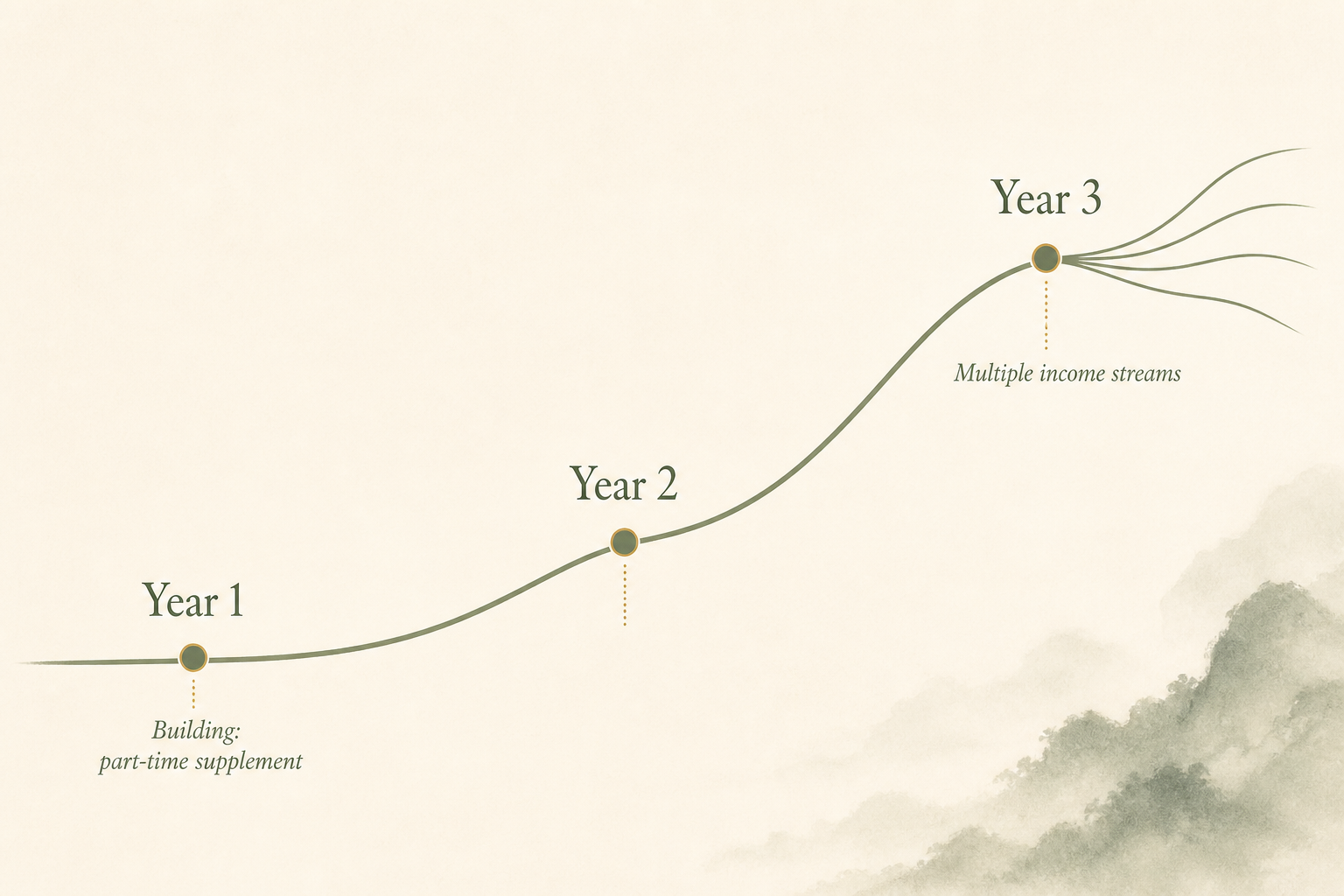
Here's the honest arc most working teachers follow.
Year 1 is usually a building year. You're teaching a class or two a week, taking on a few privates, and keeping another income source. For most new teachers this is a part-time supplement, and that's normal. The teachers who quit here are usually the ones who expected a full income from a standing start.
Year 3 looks very different for teachers who built deliberately. By now you've found your niche, you have a small roster of regulars, perhaps a recurring corporate contract, and, critically, an online offering that keeps earning between classes. Teaching across several streams is where the higher end of the salary data (and beyond) becomes realistic. The jump from year 1 to year 3 isn't usually about teaching more hours. It's about adding streams that aren't capped by hours. For a realistic view of the training timeline that comes before year 1, see how long it takes to become a qigong instructor.
How Certification Changes the Economics
Beyond opening doors to studios and corporate contracts, certification reshapes your numbers in three concrete ways. It lets you charge more from the start, because clients trust trained instructors. It qualifies you for institutional work that uncertified teachers often can't bid on. And it shortens your year 1 to year 3 ramp, because a good program teaches you not just how to move but how to sequence, cue, adapt for different bodies and run a class safely. Those skills directly affect retention and word of mouth.
Be clear on what you're actually earning, too. At White Tiger Qigong, the title Certified Instructor is awarded only after you pass the Level 5 assessment. A certificate of completion for a course shows you finished the material; it is not certification, and you shouldn't market yourself as certified on the strength of one.
Certification is also an investment with a real cost, and you should weigh that against the income it unlocks. We break the numbers down in detail in our guide to qigong teacher training cost, so you can decide whether the math works for your situation before you commit.
The Bottom Line
How much do qigong teachers make? In the United States, employed roles average around $48,000 in 2026 according to ZipRecruiter, with top earners around $78,500. But self-employed income is defined by your business model far more than by any salary table. Private rates run from tens of dollars an hour for new teachers to $500 to $1,000 an hour at the top, and a few of the best-known teachers have built businesses that bring in millions a year. Group classes and privates pay your bills in the early years; corporate contracts and online memberships are what lift you past the average. Wherever you live, research your own market, build more than one stream, get specific about who you serve, and treat certification as the foundation that makes the higher-paying work available to you.
If teaching qigong as a real career appeals to you, the first step is training to a standard clients recognize. Explore our qigong teacher certification path to see what's involved and whether it fits your goals.